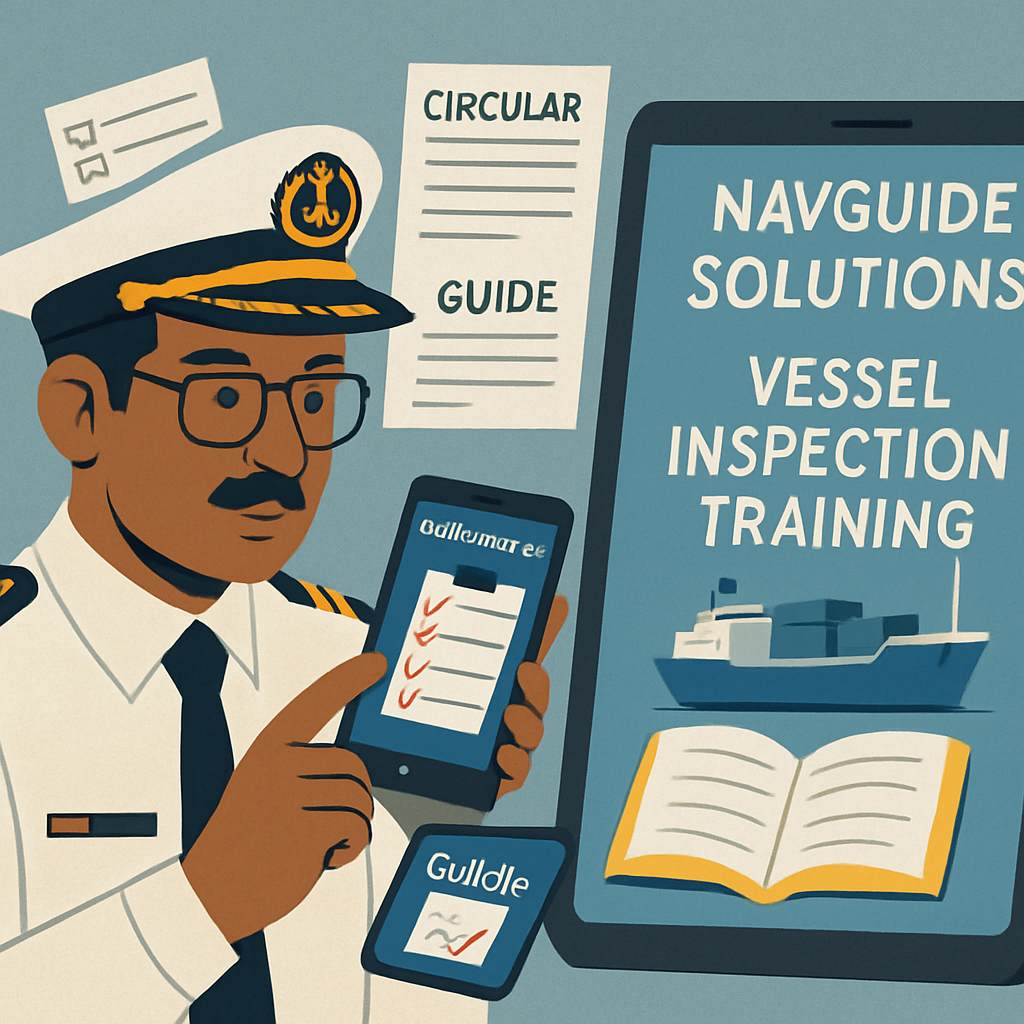
Captain Debashis Basu claims that shipping has been sending sailors more and more checklists, circulars, and guides over the years, without answering a simpler question: what does the crew actually need at the moment of work?
His answer is Guide2Inspections, an app developed by the Singaporean company Navguide Solutions, which combines onboard inspections, training, and mentoring into one offline tool.
“We wanted to make this measurable,” says Basu. “Not based on whether someone likes the training system, but on tangible improvements we can show to the ship owner.”
The app divides the ship into work zones and allows the crew to conduct self-audits using role- and vessel-specific checklists. If a sailor is unsure what a requirement means, one click opens a short video, photo, or guide showing how compliance should look. The result is an inspection report with photographic evidence that can be sent ashore, providing owners with a live overview of outstanding observations before an external auditor boards.
“If you are a second officer conducting a bridge audit and get stuck somewhere, with one click you can access a video, photo, or guide that clarifies your doubts,” he says. “You are then expected to complete the audit and demonstrate how you maintain that bridge in the company.”
The idea arose from a problem he sees in the industry. Traditional onboard mentoring has weakened as crew sizes have shrunk and workloads have increased. Basu argues that sailors are still expected to absorb much of the operational knowledge through text: SMS procedures, PMS systems, safety circulars, inspection bulletins, manuals, and emails.
“You are trying to teach someone how to do their job, and this is a very hands-on profession,” he says. “I can’t teach someone to tie a knot through text, no matter how much I write.”
The app is designed for concise, practical training. Navguide has created hundreds of three- and four-minute video guides and thousands of images showing what constitutes “good condition” and “good order” onboard. It also works entirely offline, which is critically important for vessels with limited connectivity.
Basu says the company spent three and a half years building the system's foundation, relying on auditors, inspectors, and trainers who have spent their careers onboard ships.
“This app almost acts as a mentor for every sailor,” he says. “While the ship is preparing for an inspection or audit, it also enhances the sailor’s standards.”
The platform is already being used or considered by companies such as MOL, KOTC, Enterprise, Meadway Bulkers, Unix Lines, and Apeejay Shipping, according to information from Navguide. The concept has also been presented at IMO discussions and recognized by organizations such as Intertanko, Intercargo, BIMCO, Nautical Institute, NorthStandard, and ITF.
For shipowners, the appeal lies in measurable improvements in RightShip, SIRE 2.0 results, and port oversight, with fewer delays, claims, and re-inspections. For sailors, Basu argues that the tool can support competence, confidence, and even promote career advancement.


%20scale(3)'%3E%3Cpath%20id='s'%20d='M0,-30%2017.63355,24.27051%20-28.53171,-9.27051H28.53171L-17.63355,24.27051z'%20fill='%23FF0'/%3E%3C/g%3E%3Cuse%20xlink:href='%23s'%20transform='translate(300,60)%20rotate(23.036243)'/%3E%3Cuse%20xlink:href='%23s'%20transform='translate(360,120)%20rotate(45.869898)'/%3E%3Cuse%20xlink:href='%23s'%20transform='translate(360,210)%20rotate(69.945396)'/%3E%3Cuse%20xlink:href='%23s'%20transform='translate(300,270)%20rotate(20.659808)'/%3E%3C/svg%3E)