

%20scale(3)'%3E%3Cpath%20id='s'%20d='M0,-30%2017.63355,24.27051%20-28.53171,-9.27051H28.53171L-17.63355,24.27051z'%20fill='%23FF0'/%3E%3C/g%3E%3Cuse%20xlink:href='%23s'%20transform='translate(300,60)%20rotate(23.036243)'/%3E%3Cuse%20xlink:href='%23s'%20transform='translate(360,120)%20rotate(45.869898)'/%3E%3Cuse%20xlink:href='%23s'%20transform='translate(360,210)%20rotate(69.945396)'/%3E%3Cuse%20xlink:href='%23s'%20transform='translate(300,270)%20rotate(20.659808)'/%3E%3C/svg%3E)
Maritime Sector Prepares for Transition to S-100 Standard
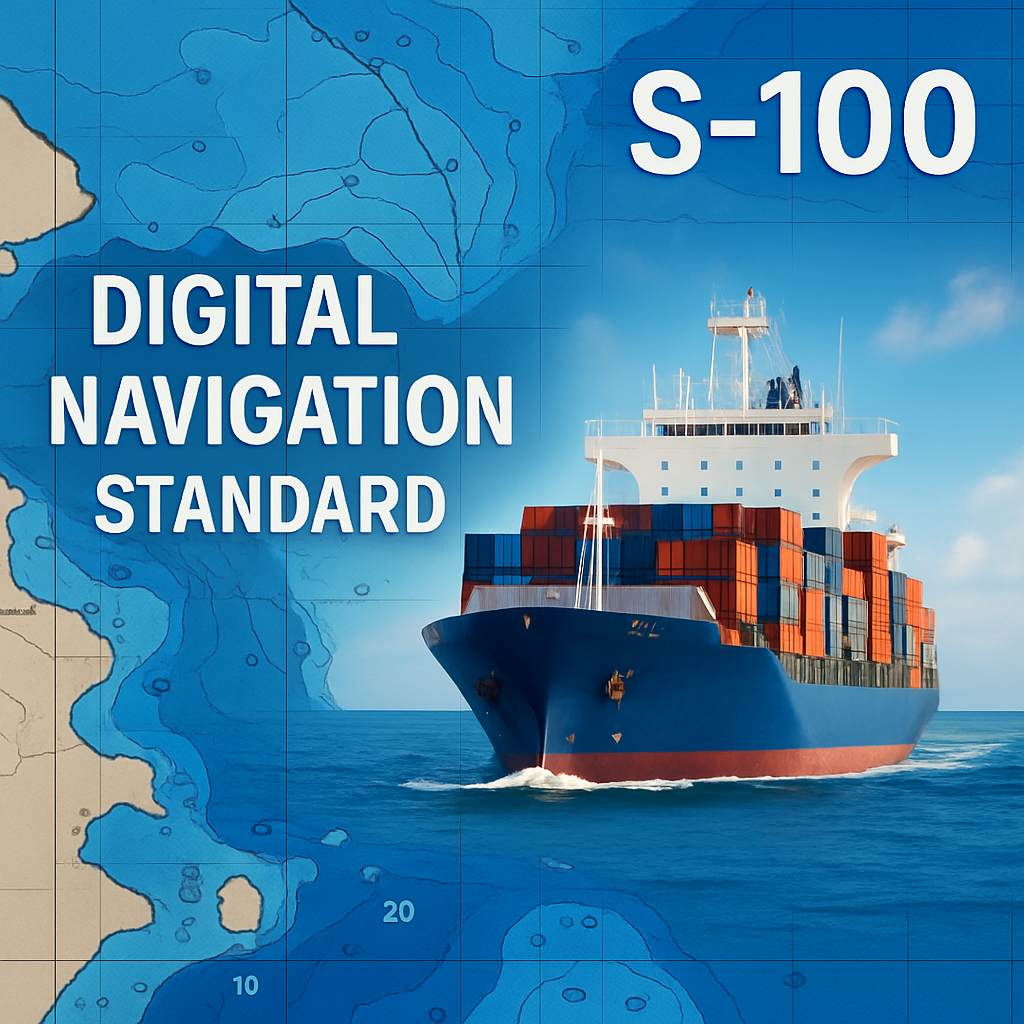
The maritime sector is approaching a significant transition with the introduction of the S-100 framework. This universal hydrographic standard, developed by the International Hydrographic Organization (IHO), will serve as the foundation for the next generation of digital navigation services and technologies, including Electronic Chart Display and Information Systems (ECDIS).
As part of the transition, the S-101 standard will gradually replace S-57 as the primary standard for Electronic Navigational Charts (ENC), while S-57 will continue to be supported in the foreseeable future. Additional layers displaying detailed and dynamic navigation data will overlay the base layer of S-101 to provide a more comprehensive view of the marine environment.
S-100 systems will be able to display compatible layers, integrating multiple data sources into a single view to enhance clarity and confidence in navigation.
By providing more accurate, up-to-date, and timely navigation data, S-100 opens significant opportunities for improved decision-making on the bridge, leading to enhanced efficiency and safety. However, to maximize this potential and ensure a successful transition, all stakeholders in the maritime industry must be prepared.
Industry expectations suggest that certified S-100 ECDIS systems could become commercially available around 2028, although timelines depend on standards, testing, and certification processes. It is important to note that these systems will be 'dual-fuel', meaning they will be able to display and utilize both S-100 and existing S-57 data. By January 1, 2029, all new or upgraded ECDIS will need to comply with the S-100 standard.
These changes will be particularly significant for mariners, who will need to familiarize themselves with navigation using the new standards and systems. The transition period provides an opportunity for mariners to test S-100 and provide feedback to data providers, technology developers, and other industry stakeholders. This collaborative approach can be used to inform further standard development, optimize systems, and training requirements, ensuring that S-100 products and recommendations meet user needs.
Ship owners and operators must also clearly understand S-100 from a commercial perspective to support the development of business cases for upgrading technologies on board their vessels and across their fleets. Gaining this knowledge ahead of upcoming regulatory milestones is vital for them to proactively engage with technology providers and assess when the transition to S-100 will be most effective for their organizations.
To better understand the practical realities of the transition to S-100, maritime industry participants are coming together to evaluate how the new data standards and next-generation ECDIS systems perform in real-world conditions.
As part of a special program to assess S-100 performance in complex and constrained waters, the UKHO recently participated in S-100 trials in restricted waters, at the IHO international testing base and testing program, in collaboration with international partners at the Carnival Corporation Simulation and Maritime Training Center (CSMART). During the trials, mariners conducted repeated approaches to ports, transits, and exits using a full mission bridge simulator equipped with S-100 ECDIS and portable pilot units (PPU).
The CSMART S-100 trials brought together a diverse range of partners, including hydrographic services, ports, mariners, maritime managers, and technology providers.
In each simulation scenario, mariners from the MV Iona and MV Caribbean Princess navigated through operationally complex scenarios, switching between various S-100 data layers, providing critical information on depths, water levels, tides, and surface currents. As a result of individual surveys and group discussions, participants provided detailed feedback on their experiences using S-100, including how it impacted navigation planning and decision-making.
One of the defining features of S-100 is its compatibility. Rather than requiring mariners to interpret information from multiple separate data sources, S-100 allows for viewing information from different providers together. While individual data products continue to serve their unique functions, their presentation in a unified environment can support a more holistic understanding of navigation conditions.