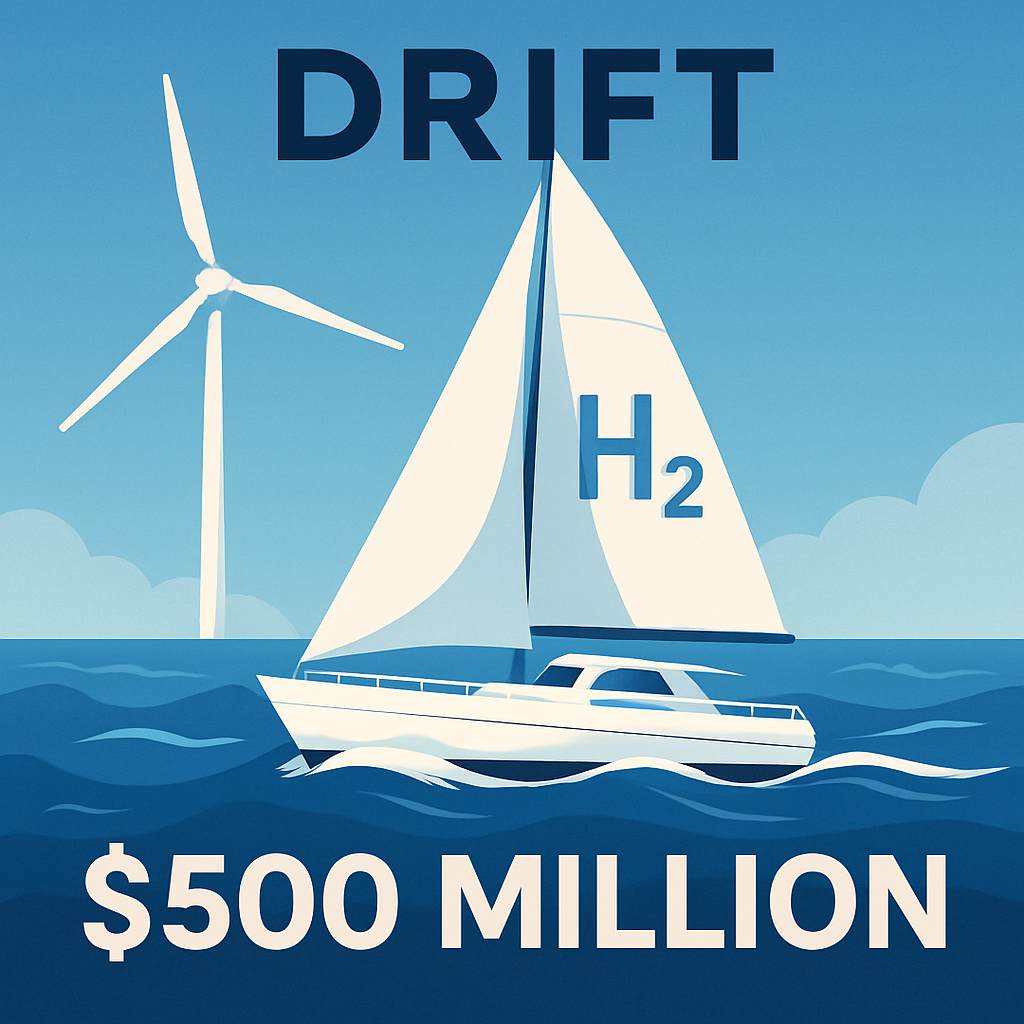
British startup Drift Energy has signed an exclusive capital and project structure agreement with Commenda Capital Partners to support the launch of at least 50 vessels that produce hydrogen using wind.
The program aims to attract over $500 million in project-level investment, which is expected to be financed through special project companies.
The company Drift will be responsible for vessel technologies, intellectual property, hydrogen production systems, routing software, as well as project development and implementation.
Commenda has been appointed as the exclusive capital and project partner for the agreed program, covering capital structuring, investor engagement, debt and equity financing processes, SPV creation, and project execution.
Drift is developing sailing vessels designed to capture wind energy at sea, produce green hydrogen on board, and deliver it to ports, islands, and coastal users.
The company claims that its vessels act as mobile offshore energy infrastructure, avoiding some of the constraints associated with grids, permits, and fixed infrastructure typical of traditional renewable energy projects.
Drift Energy CEO Ben Medland noted that the agreement with Commenda is aimed at demonstrating that the company's model is "bankable and scalable."
CEO and managing partner of Commenda Capital Partners Ulrik Andersen added that the concept still needs to be structured as a marine class asset. "It’s an innovative concept, but these are vessels. They carry maritime risks and must be financed accordingly," Andersen said.
The agreement marks the first public mandate for Commenda Capital Partners. This maritime investment company was founded late last year by Michael Ebbe Hansen and Andersen to seek, structure, and finance investment opportunities in shipping.
Andersen is a well-known figure in shipping, having previously led Golden Ocean and Avance Gas, as well as holding senior positions at Petredec and Neu Gas Shipping.
The agreement resulted from Drift's in-principle approval from RINA earlier this year for what the classification society called the first energy-harvesting vessel project to receive such approval.