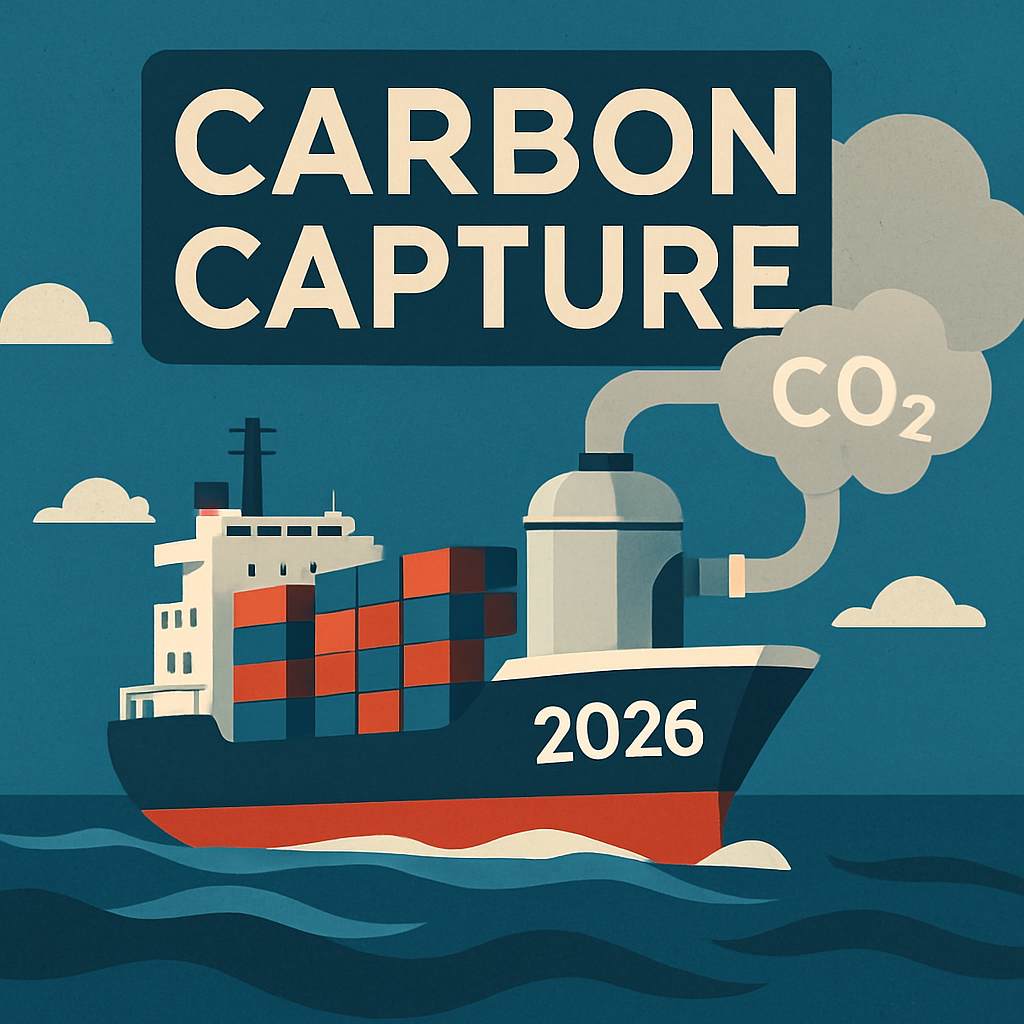
Shipping has always been a practical industry. When problems arise, the sector finds workable solutions, even if the path is rarely straightforward. Decarbonization is no exception.
According to Paul Morgan (gCaptain), low-carbon fuels are emerging, but not quickly or cheaply enough to cover the entire fleet by the 2030s. Onboard carbon capture and storage (OCCS) is becoming one of the more plausible short-term solutions. A new report from Lloyd's Register Advisory, commissioned by the International Chamber of Commerce, provides the most comprehensive independent analysis of the current state of this technology.
The overall conclusion is encouraging, albeit with honest caveats. OCCS is feasible. It has been demonstrated at sea on various types of vessels. Achieving capture rates of 70 to 95 percent is possible with the most mature systems. However, scalable commercial deployment depends on solving three interrelated issues: integration into existing ship designs, creating port infrastructure to accept captured carbon, and developing a regulatory framework that genuinely recognizes and rewards operators' actions.
Current Carbon Capture Technologies
- Post-combustion systems: dominate the current market, using amine chemical absorption.
- Calcium binding: uses different chemistry to form a solid that can be used in construction.
- Membrane separation: compact and avoids chemical processing.
- Cryogenic separation: requires significant electrical energy.
Who is leading this initiative? Wärtsilä, a Finnish engineering group, has been developing marine carbon capture since 2019. Their amine-based system has reached TRL 8 with the first installation on the Solvang LPG tanker in 2025, aimed at capturing about 70 percent of the vessel's carbon emissions.
Large tankers and gas carriers are the most promising candidates for this technology. Container ships and bulk carriers face greater challenges due to limited deck space and a lack of crew experience in handling chemical waste.
What happens to the captured carbon? The most established route is permanent geological storage, where CO2 is transported in a liquefied form and injected underground.



%20scale(3)'%3E%3Cpath%20id='s'%20d='M0,-30%2017.63355,24.27051%20-28.53171,-9.27051H28.53171L-17.63355,24.27051z'%20fill='%23FF0'/%3E%3C/g%3E%3Cuse%20xlink:href='%23s'%20transform='translate(300,60)%20rotate(23.036243)'/%3E%3Cuse%20xlink:href='%23s'%20transform='translate(360,120)%20rotate(45.869898)'/%3E%3Cuse%20xlink:href='%23s'%20transform='translate(360,210)%20rotate(69.945396)'/%3E%3Cuse%20xlink:href='%23s'%20transform='translate(300,270)%20rotate(20.659808)'/%3E%3C/svg%3E)