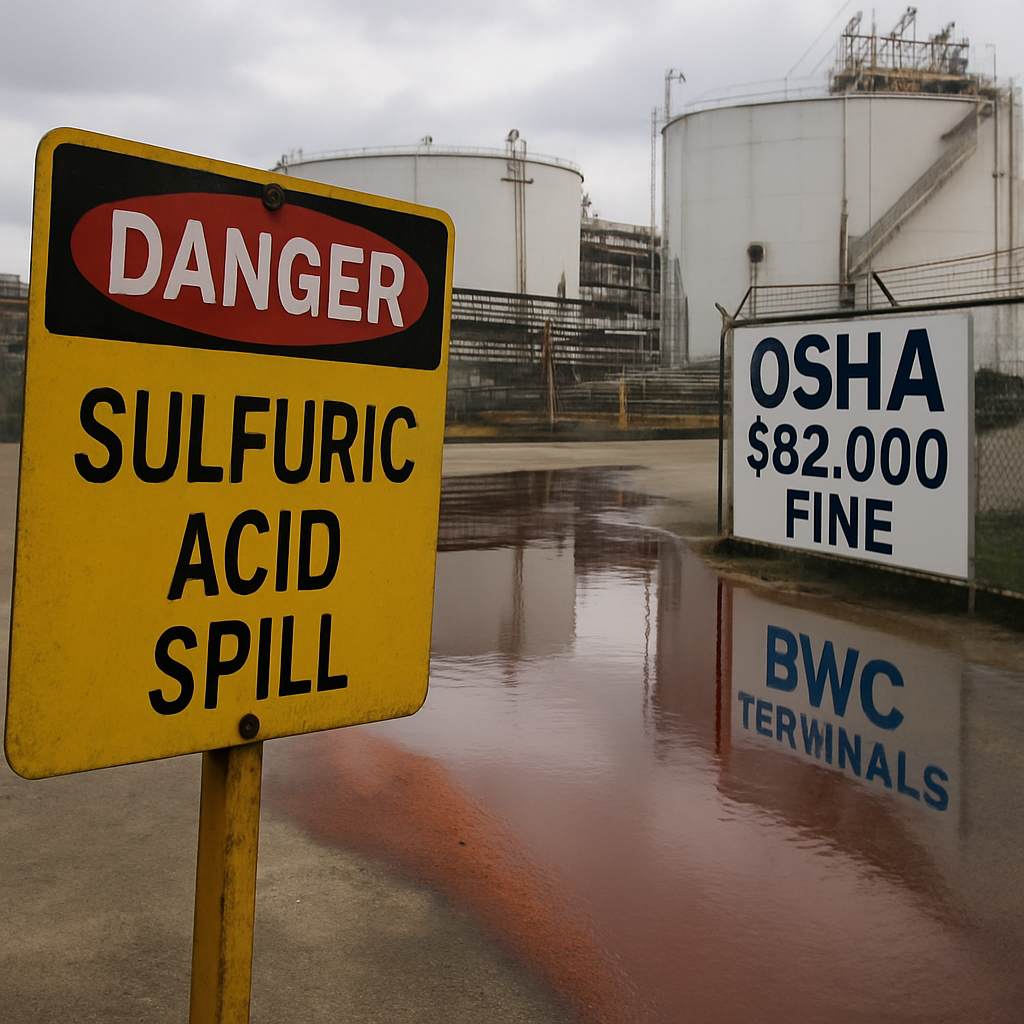
The U.S. Department of Labor has imposed a total fine of $3.5 million on the companies responsible for the sulfuric acid spill in the Houston Ship Channel last year.
The spill occurred at the BWC Jacinto site in Channelview, one of 22 facilities managed by the private company BWC Terminals across the U.S. The agency claims that an unsafe chemical mixture caused the spill, part of which entered the shipping channel. "OSHA found that despite safety warnings, BWC Terminals mixed fresh and used sulfuric acid, leading to excessive pressure in the tank, resulting in a rupture that released one million gallons of sulfuric acid and caused multiple employee injuries," the agency stated.
To address the aftermath, BWC hired Coastal Environmental Solutions and its contractor One Way Environmental Services, which provided labor for the cleanup efforts. The bulk of the fine ($3 million) was imposed on One Way Environmental, a small local company.
The ability of One Way to pay the multimillion-dollar fine is in question. The company's financial situation has been called into doubt by some of its workers, who reported to local Click2Houston in February that some of their handwritten checks had not been cashed, and that they had not been paid on time.
A group of One Way workers gathered outside the owner's home on February 4 to complain, creating enough of a disturbance for police to be called. The owner told the news agency that the delay in payroll was due to a banking issue, while some workers claimed they were owed about $4,000 per person. Payroll was issued a few days later.
OSHA claims that during the acid cleanup, One Way committed 18 willful, serious violations of safety regulations, as well as five serious violations. The agency asserts that One Way did not provide its workers with necessary training, safety measures, or respirator fit tests before sending them to clean up the sulfuric acid spill.
BWC and Coastal also received other fines. OSHA claims that BWC exposed its workers to chemical burns, failed to provide hazardous materials training, and had deficiencies in respirator use. The agency proposed a fine of approximately $82,000 as a penalty for the terminal operator for the one million gallon spill.



%20scale(3)'%3E%3Cpath%20id='s'%20d='M0,-30%2017.63355,24.27051%20-28.53171,-9.27051H28.53171L-17.63355,24.27051z'%20fill='%23FF0'/%3E%3C/g%3E%3Cuse%20xlink:href='%23s'%20transform='translate(300,60)%20rotate(23.036243)'/%3E%3Cuse%20xlink:href='%23s'%20transform='translate(360,120)%20rotate(45.869898)'/%3E%3Cuse%20xlink:href='%23s'%20transform='translate(360,210)%20rotate(69.945396)'/%3E%3Cuse%20xlink:href='%23s'%20transform='translate(300,270)%20rotate(20.659808)'/%3E%3C/svg%3E)