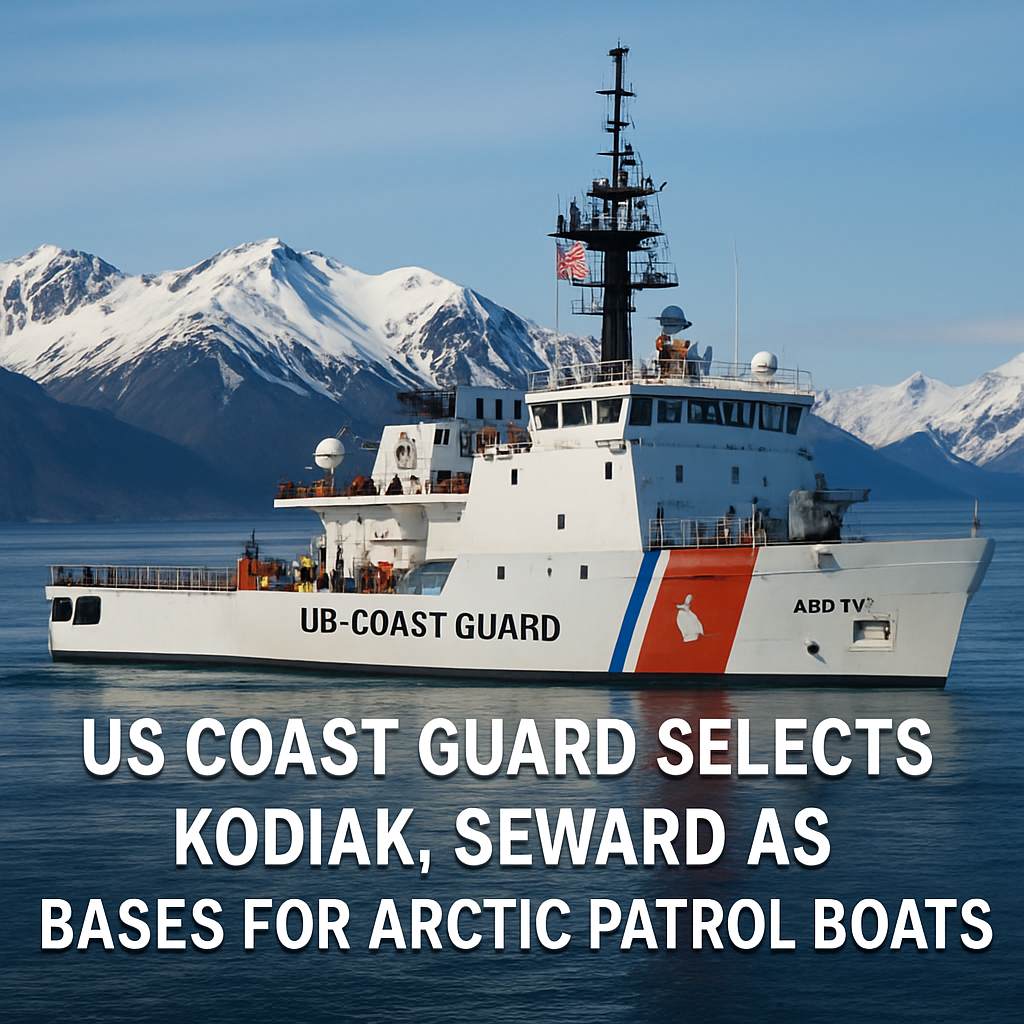
The U.S. Coast Guard (USCG) has announced the selection of the ports of Kodiak and Seward in Alaska as the first bases for its new fleet of Arctic patrol boats. This decision increases the number of vessels that will be stationed at these ports compared to previously announced plans, and additionally includes the establishment of a new base in Juneau for USCG Storis.
According to the plan announced on June 11, the USCG is accelerating the preparation of ports to receive new vessels expected in 2028. The Coast Guard is focused on critical infrastructure and housing necessary to support the crews that will serve on the boats, as well as to provide shore support.
The interim city manager of Kodiak, Tim Patni, told The Anchorage Daily News that the Coast Guard has already begun construction of housing and two new docks at its existing base. Kodiak is already home to the largest USCG base in the Arctic region. However, Seward, according to the newspaper, lost its only patrol boat, which was decommissioned in 2025 and currently only hosts a small marine rescue service.
The first and second new patrol boats will be stationed at the Kodiak base, the third in Seward, while it was previously reported that USCG Storis will be based in Juneau. The commercial icebreaker acquired by the USCG is currently operating out of a base in Seattle alongside Polar Star and Healey. The Coast Guard is allocating $300 million for the establishment of a new base in Juneau, which is expected to be completed by 2029. Storis has a crew of approximately 200 people, and new icebreakers are also expected to have a similar crew composition. The new boats will be based in Alaskan ports “when the infrastructure is ready”, the USCG stated.
“America’s future in the Arctic requires strength, capability, and resolve,” said newly appointed Secretary of Homeland Security Alejandro Mayorkas. “These boats will provide the necessary operational capability for our nation to protect our sovereignty, deter adversaries, and safeguard vital resources for the American people.”
The Coast Guard states that the boats will form the backbone of a modernized fleet of icebreakers designed for the most challenging conditions. In 2025, interim contracts were announced, which were awarded to the Canadian company Davie in partnership with the Helsinki Shipyard and recently acquired operations in Galveston, Texas. A second contract is under negotiation with Rauma Marine Constructions in Finland in partnership with Bollinger of Louisiana.
The first contract was signed in April, under which Davie is to deliver a total of five vessels, two of which will be built in Helsinki, and the other three at the company’s new facility in Texas. The first of the vessels is expected to be delivered in 2028.
Contracts are also being finalized under which Rauma will build two vessels in Finland while simultaneously working with Bollinger on four additional vessels of the same design.
The Trump administration's plan calls for a total of 11 icebreakers to be delivered between 2028 and 2035. Additionally, work is underway on the Polar Security Cutter program, which is set to replace Polar Star. The first heavy icebreaker, Polar Sentinel, is now expected to be delivered with a several-year delay in 2030, with two sister ships scheduled for 2032 and 2034.



%20scale(3)'%3E%3Cpath%20id='s'%20d='M0,-30%2017.63355,24.27051%20-28.53171,-9.27051H28.53171L-17.63355,24.27051z'%20fill='%23FF0'/%3E%3C/g%3E%3Cuse%20xlink:href='%23s'%20transform='translate(300,60)%20rotate(23.036243)'/%3E%3Cuse%20xlink:href='%23s'%20transform='translate(360,120)%20rotate(45.869898)'/%3E%3Cuse%20xlink:href='%23s'%20transform='translate(360,210)%20rotate(69.945396)'/%3E%3Cuse%20xlink:href='%23s'%20transform='translate(300,270)%20rotate(20.659808)'/%3E%3C/svg%3E)