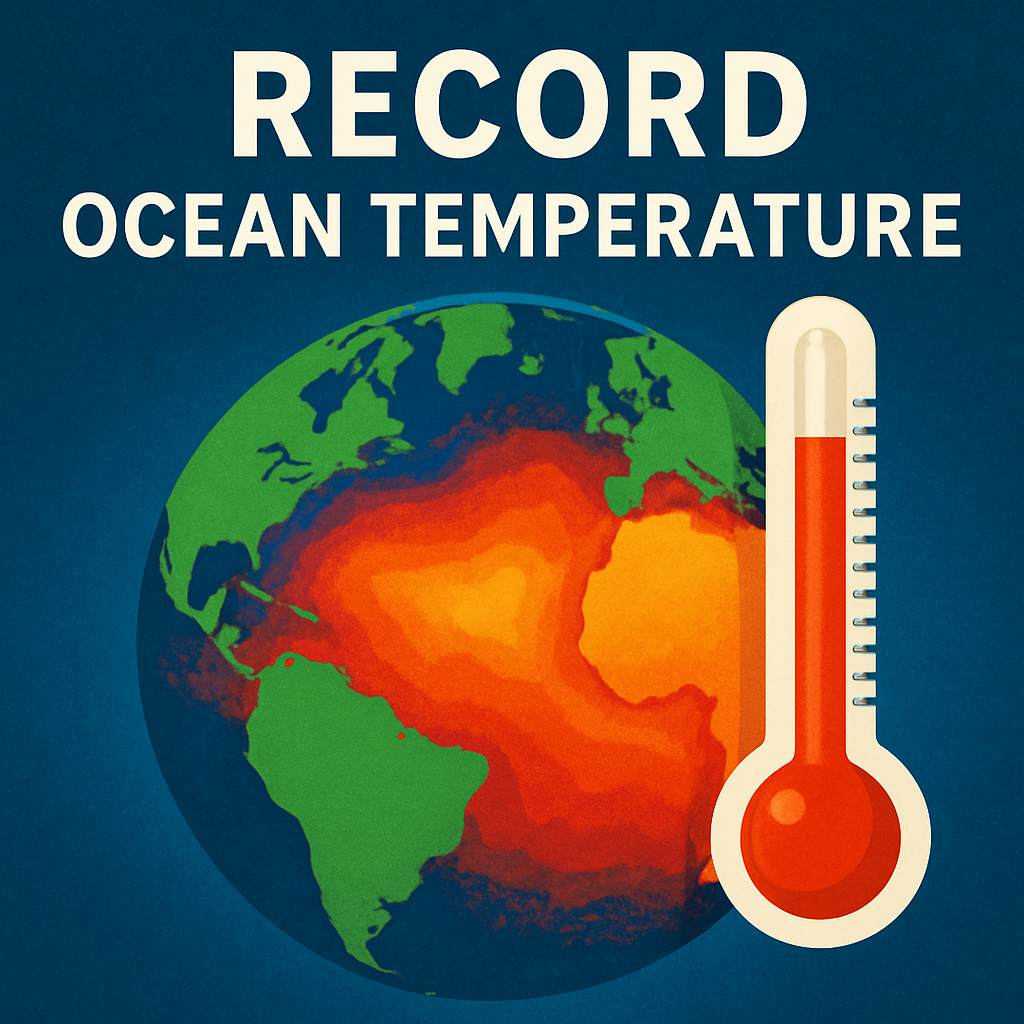
Against the backdrop of record summer heat in Europe, the EU-sponsored Copernicus Marine Service reported a new record for global ocean surface temperature, making 2026 the third year in the last four that this threshold has been exceeded.
The difference is small, about 0.1 degrees Celsius compared to previous records on June 21, and this was expected. With the arrival of El Niño conditions in the Pacific Ocean and observed high temperatures in other ocean basins, the average temperature was predicted to rise, and new daily records are expected to be set in the coming weeks.
The new daily record was confirmed by the sister organization, the European Centre for Medium-Range Weather Forecasts (ECMWF).
Carlo Buontempo, director of the Copernicus Climate Change Service at ECMWF, noted: "With ocean temperatures at such levels and El Niño on the horizon, we are likely to see more temperature records in the coming months. The fact that Copernicus data reaches the same conclusion using independent methods speaks to the strength of European science and why open, reliable data is more important than ever."
El Niño events cause a sharp rise in surface temperatures in the equatorial eastern Pacific Ocean, impacting weather patterns worldwide. An increase in average global air temperature and more extreme weather events (droughts, storms, and heatwaves) typically accompany El Niño years. Climate scientists expect that 2027 will bring record global temperatures driven by El Niño conditions, and the impacts may be unique this year due to the scale of the current event.
Climatologist Kim Cobb told CNN: "This El Niño is unusually large for this early in the year, and it is occurring in a warmer climate that is fundamentally different from past decades."
Ocean surface temperatures are an important part of the overall weather picture, but the rest of the ocean is also getting warmer. Last year, deep ocean waters at depths of 0 to 2000 meters set a new heat record, as reported by a joint Chinese-American research team in the journal Advances in Atmospheric Sciences.
In a related article in the journal Nature Climate Change, written by many of the same authors, researchers emphasized that this work relies on the integrity of the global network of sensors established by many countries but supported by U.S. investments in research. Any cuts to this international partnership, known as the Global Ocean Observing System, such as the previous removal by the Trump administration of a $370 million deep ocean monitoring megaproject, will reduce the quality of future ocean heat data. This will have a significant impact on climate research, experts in the field argue.
French oceanographer Sabrina Speich told The Guardian: "Ocean heat content is the most reliable indicator of climate change we have - not only of what is happening in the ocean but of the entire climate system. If we lose them, we lose the ability to track not just ocean warming but the climate system as a whole."



%20scale(3)'%3E%3Cpath%20id='s'%20d='M0,-30%2017.63355,24.27051%20-28.53171,-9.27051H28.53171L-17.63355,24.27051z'%20fill='%23FF0'/%3E%3C/g%3E%3Cuse%20xlink:href='%23s'%20transform='translate(300,60)%20rotate(23.036243)'/%3E%3Cuse%20xlink:href='%23s'%20transform='translate(360,120)%20rotate(45.869898)'/%3E%3Cuse%20xlink:href='%23s'%20transform='translate(360,210)%20rotate(69.945396)'/%3E%3Cuse%20xlink:href='%23s'%20transform='translate(300,270)%20rotate(20.659808)'/%3E%3C/svg%3E)