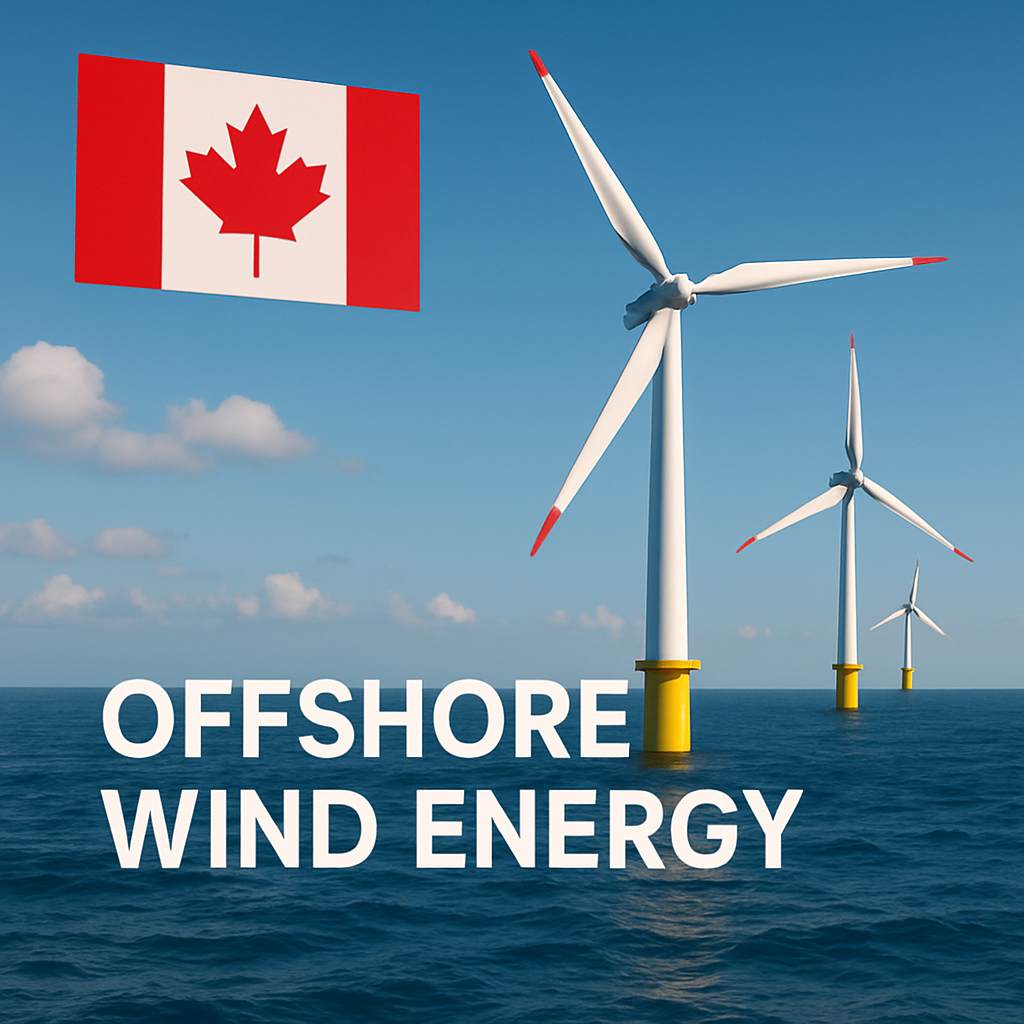
Canada and the province of Nova Scotia have taken an important step towards developing offshore wind energy by designating companies that have passed preliminary qualification to participate in the bidding process. Government officials noted a strong presence of international participants, confirming the potential to become a global hub for offshore wind energy.
The Canadian Nova Scotia Offshore Energy Authority (CNSOER), an independent joint agency created by the governments of Canada and Nova Scotia, conducted the preliminary qualification. It established criteria for the financial standing of participants, as well as technical, legal, and social aspects that were considered in the evaluation process.
“By attracting companies with experience and expertise to deliver large energy projects, we are laying the groundwork for a successful offshore wind industry at home,” said Nova Scotia Premier Tim Houston.
Among the five companies that were announced as having passed the preliminary qualification are well-known developers, including DEME from Belgium, Jan De Nul from Luxembourg, and Ming Yang from China. Two groups also qualified, one of which includes Hanwha Ocean, working with Q Energy France. However, the regulator noted that companies also had the option not to disclose their status at this stage of the program.
Canada plans to open official bidding for the first offshore wind sites in the country later this year. Applications will be reviewed at both federal and provincial levels before winners of the tender are announced.
The first sites designated for auctions were announced in July 2025. A total of four sites were announced, including three east of Nova Scotia and one to the north. Three of them (Middle Bank, Sable Island Bank, and Sydney Bight) will be located at least 25 kilometers offshore and at depths suitable for fixed turbines. The fourth site, French Bank, will be closer — at a distance of 20 kilometers, with significantly deeper waters, which may require the use of floating turbines. The province is considering additional sites.
The government reported that the first request for proposals will be for a modest 2.5 GW, followed by additional rounds. The goal is to license 5 GW by 2030.
Premier Tim Houston advocates for a bold vision for the industry. He aims to make Nova Scotia an energy exporter. While Nova Scotia currently has a peak electricity demand of about 2.4 GW, Houston forecasts that the industry could grow to a generating capacity of 40-50 GW by 2050, making it an energy exporter.
Massachusetts is reported to be one of the potential markets for Canadian wind energy. The state is seeking new sources of renewable energy after the Trump administration halted New England's efforts to develop offshore energy capacity.



%20scale(3)'%3E%3Cpath%20id='s'%20d='M0,-30%2017.63355,24.27051%20-28.53171,-9.27051H28.53171L-17.63355,24.27051z'%20fill='%23FF0'/%3E%3C/g%3E%3Cuse%20xlink:href='%23s'%20transform='translate(300,60)%20rotate(23.036243)'/%3E%3Cuse%20xlink:href='%23s'%20transform='translate(360,120)%20rotate(45.869898)'/%3E%3Cuse%20xlink:href='%23s'%20transform='translate(360,210)%20rotate(69.945396)'/%3E%3Cuse%20xlink:href='%23s'%20transform='translate(300,270)%20rotate(20.659808)'/%3E%3C/svg%3E)