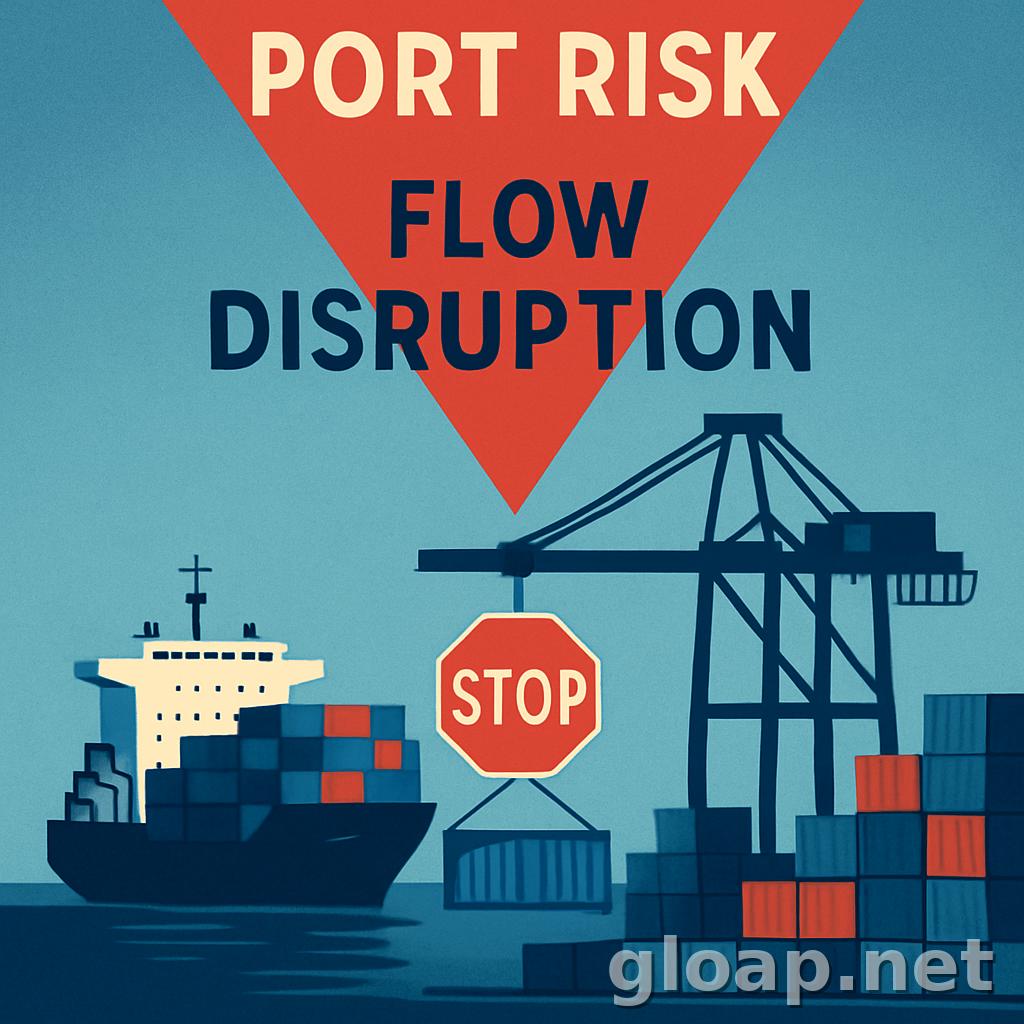
Port efficiency metrics are changing: traditional indicators such as cargo volume, vessel calls, crane productivity, and infrastructure capacity do not fully reflect financial vulnerability. According to material by Sabrina Brigance, the key risk for a port is the disruption of cargo flow itself, which directly affects revenue.
Why this is so
Every vessel call, gate move, crane assignment, cargo release, and intermodal transfer generates revenue and fulfills customer obligations. If traffic slows down or stops, financial losses begin to accumulate almost immediately—often before physical damage is identified and an insurance claim is filed.
Key takeaway
A significant part of losses is linked not to catastrophic infrastructure destruction, but to operational failures: congestion, equipment breakdowns, cyberattacks, theft, labor shortages, weather instability, and supply chain dependencies. These factors disrupt cargo flow, causing:
- real-time revenue shortfall,
- increased operating costs,
- fines and penalties under contracts,
- concessions or waivers to customers,
- diversion of cargo to competitors.
Risk #1. Cargo concentration amplifies the impact of disruptions
More efficient yet denser transport patterns (large vessels, tight delivery windows, centralized distribution models, seasonal peaks) mean that in certain periods, greater value, obligations, and revenue are concentrated on the same assets: equipment, staff, IT systems, and transport links.
Average per-day load calculations can underestimate the real threat. Therefore, the critical question is: what share of revenue would be at risk at peak congestion?
During peak periods, demurrage and detention can occur, delivery deadlines can be missed, yard congestion can increase, and additional costs for clients can escalate into contractual disputes. To reduce risk, the text recommends pre-planned diversification and redundancy schemes: diversion routes, temporary storage zones, alternative transport options, and capacity ramp-up plans.
Risk #2. Revenue loss starts before physical damage is recorded
Higher productivity through powerful cranes, automated gates, integrated terminal systems, and strict labor coordination reduces tolerance for disruptions. If a critical crane fails, gates become unavailable, or a key service node breaks down, the chain is immediately disrupted:
- floating vessel schedules are shifted,
- cargo accumulates,
- synchronization with road and rail flows becomes more complex,
- pressure on customer commitments increases.
Even without confirmed physical damage, revenue begins to leak out of the process. The author highlights the need for mapping critical assets and workflows, as well as coordination between operations, technical teams, security, finance, and risk management.
Management readiness is also essential: when processing speed drops, it is critical to understand, who can reroute cargo, reset operation sequence, cap flows, or activate an alternative plan. In some cases, the problem is not the absence of a plan, but unclear authority—and that also costs money.
Risk #3. Major financial damage can occur outside the port boundary
A port is a node in a large chain: carriers, trucking, rail, warehouses, utility providers, tenants, customers, and public authorities. A disruption at any participant can stop movement in the port.
Possible effects from the source material:
- rail outages increase terminal dwell time,
- warehouse closure blocks container release,
- power supply failure limits operations even when infrastructure remains intact,
- carrier schedule changes create new congestion or idle capacity.
Even if the port is not the source of the problem, the financial consequences often remain there: demurrage, detention, congestion-related costs, penalties, and schedule failures.
What matters
According to the analysis, port teams should assess in advance:
- how much revenue is lost for each day of cargo flow stoppage,
- with whom along the chain business continuity planning must be coordinated,
- when and at what level escalation should occur so decisions are made before congestion escalates.
Managing continuity and financially critical nodes in the cargo flow is presented as the key to reducing risk and preserving port profitability.

 GLOAPM.COM