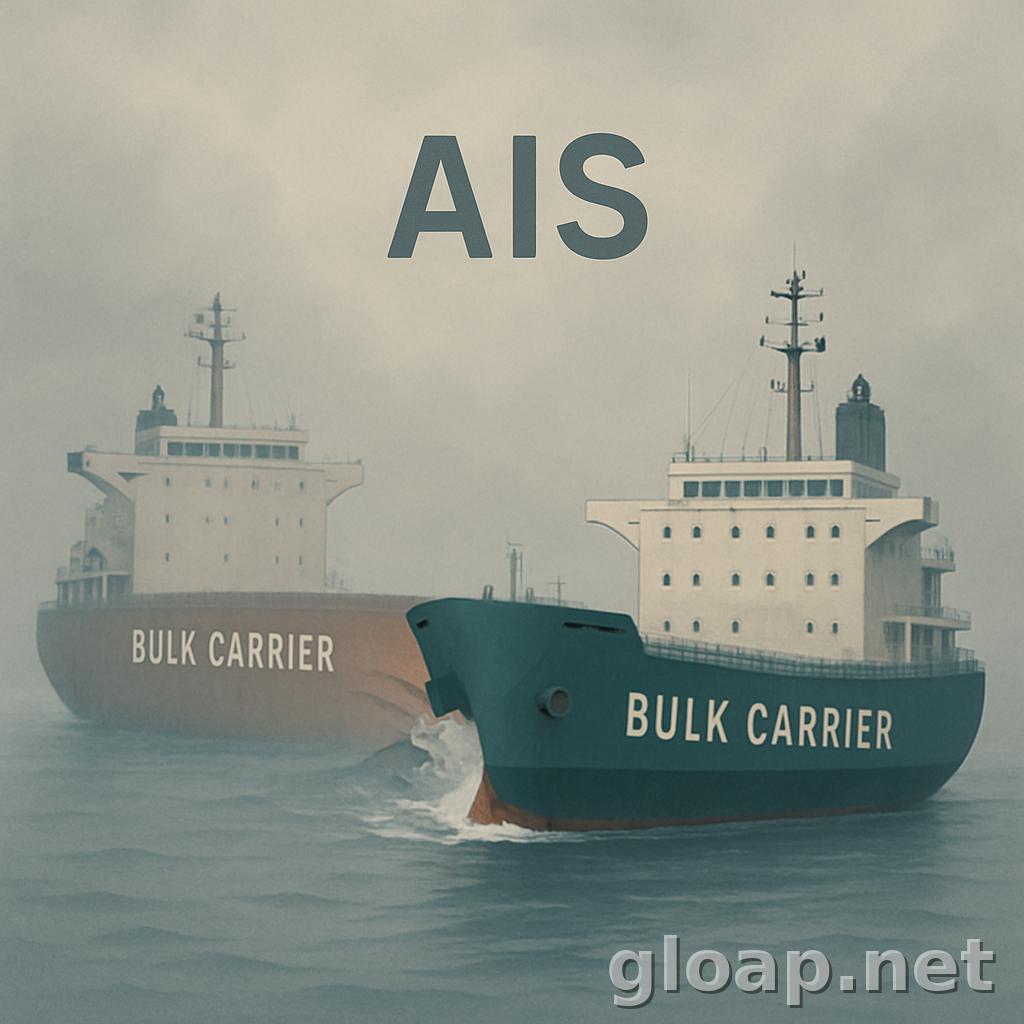
The Nautical Institute summarized safety lessons from an incident in which two bulk carriers collided in dense fog while overtaking on a traffic separation scheme (TSS) route. As stated in the report, the decisive factor in the developing emergency was the combination of continuous visual restrictions and insufficient crew response.
Key circumstances
Vessel Vessel A was sailing loaded in the traffic separation zone at about 7.6 knots with visibility of roughly 350 m. Because of the fog, the master initiated enhanced watchkeeping on the bridge: he was in charge on the bridge, two additional navigation officers were also on the bridge, and the helmsman was at the wheel.
Despite this, Vessel A’s bridge did not detect that Vessel Vessel B was overtaking from astern. Its radar picture was intermittent, and the target was never identified on the radar display as a separate radar contact.
Why the accident became possible
Vessel B was not transmitting an AIS signal. Neither vessel transmitted the required prolonged signal of one long blast every two minutes, which is required in restricted visibility under collision-avoidance rules.
Vessel B was making full speed, about 11.8 knots, with automatic steering engaged. Its bridge was manned by the watch officer and a lookout. The watch officer of Vessel B saw Vessel A but did not report the reduced visibility to the master.
Further development of events
VTS advised Vessel A to proceed to anchor waiting position or drift, as visibility in the TSS was too poor and movement in the area had effectively been suspended. Minutes later, the master of Vessel A saw a clear opposing lane and ordered a speed reduction and turn through it to execute instructions for an emergency position.
The VTS operator agreed with the maneuver, but did not have accurate data on the position of Vessel B either, due to the absence of AIS and unstable radar.
Only when Vessel B realized the dangerous closeness did the bridge officer call Vessel A on VHF. A reply was received, but no further tactical discussion followed. Within seconds, the vessels came into visual contact.
Collision and conclusions
Captain Vessel A, seeing that Vessel B was near the stern, ordered “hard right” to avoid.
Vessel B responded with “hard left,” but the collision proved unavoidable: both ships collided bow-to-bow, with impact on the port side of Vessel A. The damage was significant on both vessels.
The incident confirms the principal conclusion of the report: AIS increases awareness, but it does not replace proper visual and radar watchkeeping, timely signal exchange, or a sequential decision-making process for actions in restricted visibility.
 GLOAPM.COM