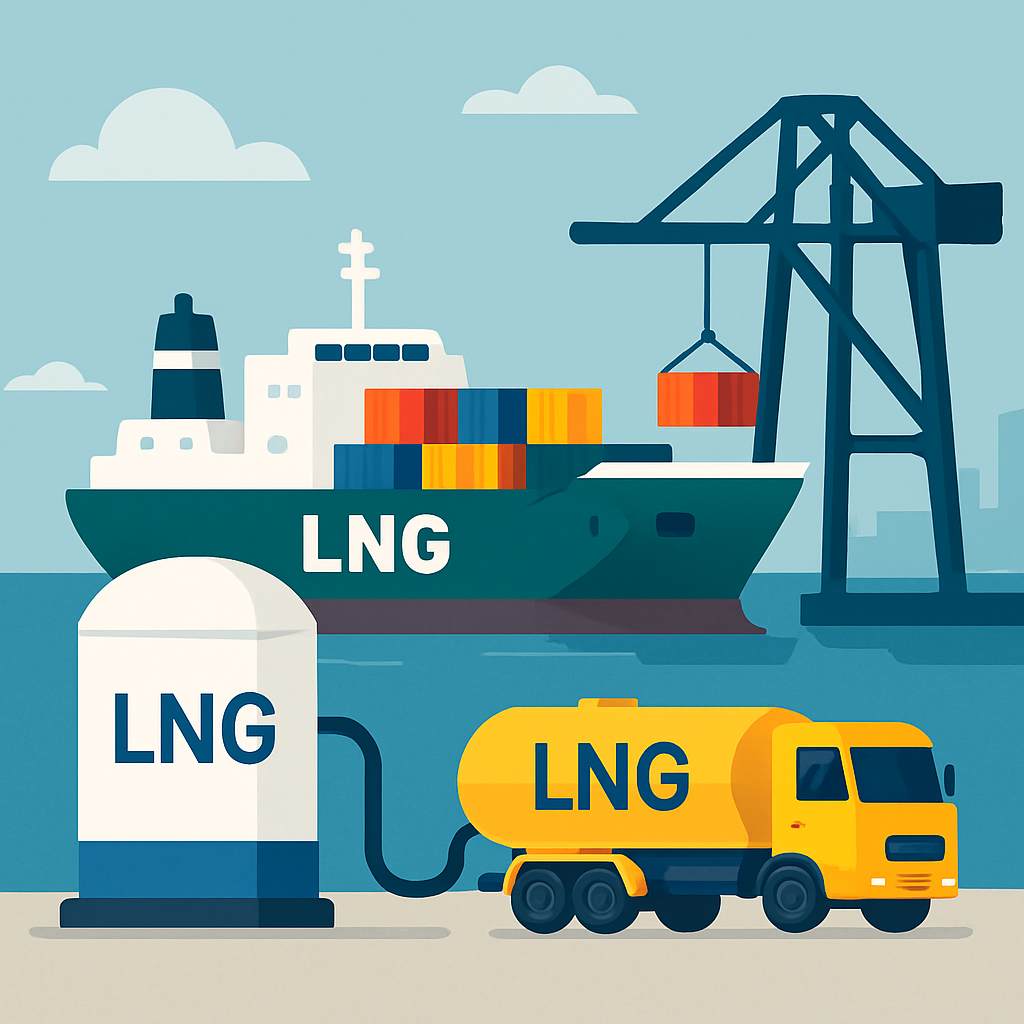
As of February 6, 2026, liquefied natural gas (LNG) bunkering has become available in 222 ports globally. This infrastructure continues to expand actively, providing shipowners and routes with alternative fuel in line with environmental standards.
Expansion of Bunkering Infrastructure
According to recent data, the number of ports offering LNG bunkering services has reached 222 worldwide. Additionally, another 62 ports plan to implement such services in the near future. This reflects rapid growth in capacity: the number of specialized LNG bunkering vessels in operation has increased to 62 units by 2025, compared to just one vessel in 2016.
Economic Aspects and Market Trends
Global bunker indices from MABUX for the 6th week showed mixed changes without significant shifts. The 380 HSFO index rose by $1.24, reaching 425.67 USD/MT. The price difference (SS Spread) maintains the advantage of conventional fuel VLSFO over the combination of 380 HSFO with a scrubber. In the port of Sines (Portugal), the price of LNG decreased by $83 to 896 USD/MT, but the difference with MGO LS was $119 in favor of the latter.
Importance for Shipping
The expansion of the LNG bunkering network is crucial for planning the transition to alternative fuels and optimizing routes. This is particularly relevant for companies considering infrastructure and environmental requirements. The industry is experiencing a consistent increase in capacity, highlighting the growing demand for LNG as a bunkering fuel.



%20scale(3)'%3E%3Cpath%20id='s'%20d='M0,-30%2017.63355,24.27051%20-28.53171,-9.27051H28.53171L-17.63355,24.27051z'%20fill='%23FF0'/%3E%3C/g%3E%3Cuse%20xlink:href='%23s'%20transform='translate(300,60)%20rotate(23.036243)'/%3E%3Cuse%20xlink:href='%23s'%20transform='translate(360,120)%20rotate(45.869898)'/%3E%3Cuse%20xlink:href='%23s'%20transform='translate(360,210)%20rotate(69.945396)'/%3E%3Cuse%20xlink:href='%23s'%20transform='translate(300,270)%20rotate(20.659808)'/%3E%3C/svg%3E)